Showing posts with label Tightness. Show all posts

Monday, October 18, 2021

Tootsie's "TWEET:" Don't Wait Until It's Too Late

It's me again, Emily's alter-ego, Tootsie, "Queen of the Posture Police."  I'm tired of Emily being so nice to you all!! I'm here to keep it real and offer some unfiltered advice so you feel better & STAY better!!  I'm here to blow my whistle and make another citation for crappy posture! 

TWEET! Don't Wait Until It's Too Late!!  

It's so annoying!  That lingering, dull ache when you bend or reach. It's been bothering you for some time now, but you just keep hoping it will go away...eventually. But it is still there. It's not convenient, but you move on. It doesn't seem to matter what you do, it is still there. You've tried stretches. It's still there. Your Chiropractor gets your alignment straight and you feel better for a little bit, but it's still there. Your Massage Therapist tries to untie the knot in that area, but it tightens back up. Then all of a sudden, you move the wrong way and your body locks up completely!! You have to cancel all of your plans and let your body calm down for who knows how long!! Again, not convenient, but this time you can't move at all!  Now, what are you supposed to do??

Good question. I know the answer. (Emily is too nice to share it, so here I go!) DON'T WAIT!! That little annoying ache, that all of a sudden turns into an emergency could have been dealt with much better in Emily's office when it was a molehill, rather than a mountain. You know how it goes on Emily's treatment table..."Move this way...Hold here...Ready, RESIST! Roll over, lift this leg, Hold, Ready RESIST! Now roll back over. Stand up. Sit down. Move this way, Ready RESIST!" Good luck trying to do any of THAT when your body is in crisis-mode, crying out in pain! 

Here's the deal. When your body has trouble MOVING or you can't MOVE a certain way, your muscles are involved. When you feel tight or have a "knot," your muscles are involved, but I'm here to tell you, those stretches won't help! When your posture and alignment are out of place, your muscles are involved; when your alignment is put back into the ideal position, if the muscles that hold it there aren't on board, your crappy alignment will shift right back to where it once was. It is as simple as that! Fortunately for you, YOU happen to have your own personal Muscle Specialist. You know who to call when your body is starting to send you the uncomfortable messages. You know NOT to wait until it is too late.  

A few weeks ago, Emily got a call from a client she hadn't seen for several months. All of a sudden, this client reached out in crisis mode. "I NEED to get in for a session! My body is ANGRY!!" Unfortunately for this client's sake, Emily's calendar was full of clients who had already been on her schedule for weeks, committed to working on the process of moving better after their body gave them subtle warning signs. This client waited until it was too late! She waited until her body was screaming at her!! Not only would she have been miserable on the treatment table, trying to move into the range-of motion positions needed for Emily to figure out the best way to help her, but the hands-on and exercise treatments themselves would have been more painful to endure as well in her inflamed state. 

Even though she is a PT (which some people think stands for "Pain & Torture"...), Emily truly does NOT like to hurt her clients!! Seriously, she doesn't!! She knows that it will be painful for her clients to be treated when they are in an active crisis mode. Of course, IF she is able to help, Emily will see her clients in whatever state they show up to the session, but it goes much more easily for everyone involved if the sessions are focused on promoting wellness rather than doing damage control. (But she's too nice to say anything, so that's why I'm bringing it up!) 

So, in summary, listen to those body signals, people!! Even if the message seem just like a little "whisper" right now, these quieter messages are important indicators that something may get MUCH louder if you wait too long to have your muscles checked! Maybe you've been told by a friend or family member that your posture needs help, or you've noticed uncomfortable sensations in your body with all the stress & changes you've been through since 2020, or you've been dealing with a chronic, nagging ache for years and you just keep on plugging away. Now, bring your mole-hills in to see Emily before they become mountains!! 

DON'T WAIT!!! Call, Text (414) 405-3956, or Email 1212bodyworks@gmail.com to set up your next session! 


Thursday, January 14, 2021

How do you really WANT to FEEL??

WE MADE IT!! Here we are, settling into 2021. What a crazy year we all had in 2020, but the important thing is that we made it through!! Every year, many people like to reflect on the previous year and then look ahead to the new year as a fresh start.  Many people set resolutions as in "This year, I'm going to stop snacking after dinner," or "I'm going to start walking every day," or after 2020, a resolution might be "I'm going to stop finishing a bottle of wine every night!" Many people make resolutions involving something that they want to stop doing or start doing, and often these resolutions have something to do with improving health. Often times, a few weeks or even a month or two will go by with the best of intentions, but then the efforts toward the resolutions fade out or stop all together. I know this because this often happens to me! This year, I did something different and it has already impacted my life so much in two weeks that I HAD to share it with you! 

My childhood friend, Kristen Finch, is a Life Coach and the hostess of the Podcast "Show Up and Love." She has a podcast episode about setting "Re-SOUL-utions" and she offers a simple yet very effective way to actually make positive changes in your life. Give it a listen HERE. Instead of focusing on stopping or starting something, she recommends you focus on how you want to FEEL about 9 categories in your life: Body, Mind, Work, Marriage/Relationship, Family, Home, Money, Soul, and Life. Once you have the feelings identified, you make a list of all of the activities you can do to help you get to the feeling place for each category. By being focused on how you want to feel in these various areas, you will be more likely to make choices that will lead you to the feeling place. I re-read my "Re-SOUL-utions" daily and sometimes re-write them and I can already feel a difference in most of those categories! Sometimes simple things make the biggest difference. 

I started thinking about how I can use this concept to improve my client sessions. Most clients I see have some sort of "not-so-good" sensations in their body, such as pain, tightness, or stiffness. Or, they have some "not-so-good" movements that restrict their ability to perform their daily tasks or fully enjoy their life. Up until now, I've always started the sessions asking "How are you feeling?" Then, my clients report where their aches and pains are located, or which movements are limited. As a PT, I've always taken responsibility for trying to help get rid of those "not-so-good" sensations. Many clients feel better in their bodies after moving through our treatment sessions with the therapies and exercises used to help their body's efficiency improve. But one session is not a cure-all and often doesn't help to fully resolve the undesired sensations, especially if those sensations have lingered for a long time. Sometimes I would feel unsuccessful if I wasn't able to take someone's pain away in a session or even throughout a series of treatments, which would then turn into feelings of negativity, sadness, disappointment with myself, and lack of confidence in my abilities as a therapist. After listening to the podcast and doing the work to identify the way I WANT to feel in my life, it made me realize that I have been focused on the wrong sensations with my clients. Now, instead of just asking where the "not-so-good" sensations are located, I have started asking clients "How do you WANT to FEEL in your body?" The answers have been simple, yet profound sometimes. So far, clients have shared that they want to feel "relaxed," "free," "flexible," "youthful," "vibrant," and "energized." By spinning the focus to something so much more positive and desirable  the level of satisfaction with our sessions has improved, both from the client perspective and from mine as the providing therapist. What a relief! And what a simple way to  make such a huge difference! 

So, how is it that YOU want to FEEL in your life? In your Body? What do you want to be able to DO more easily? What happens as you start to focus in on those feelings and activities? Is there something you can do to make yourself feel just a little bit better? Is there something I can do to help you feel just a little bit better? 

I'd love to hear how this process is beneficial for YOU as you begin the fresh start of this new year! My hope is that you find ways to feel relaxed, free, flexible, youthful, vibrant, energized or any other way that YOU want to feel EVERY day this year! 


Monday, June 27, 2016

8 Key Elements to a Well-BALANCED Life: "A" is for...

How many times has a parent, teacher, or someone else in your life told you to sit or stand up straight? Most people know that ideal posture is important, but don't always consider why. Leave it to me, the muscle nerd, to fill you in on why having proper posture is important to your health and how learning to monitor and adjust your body's ALIGNMENT can save years of pain and dysfunction.

Your muscular system is responsible for 3 main functions: 1. Align your skeleton, 2. Create movement, 3. Control movement. Weak or tight muscles cause imbalances which pull your body out of correct alignment,  resulting in less efficient movements and more stress on your entire system. If your muscles are not working properly due to stress, trauma or overuse, your everyday postures could be doing more harm than you realize! Improper alignment can lead to difficulty taking a full breath, pinched nerves, headaches, neck and back pain, knee and shoulder injuries, foot dysfunctions, and the list goes on!!  

"What is ideal alignment," you might be wondering, "and how can I prevent myself from having some these problems?" The answer is dependent on whether you are standing, sitting, lying down, etc. This post will focus on your standing posture. Let's start from the ground and work up, as this sets up a solid foundation. 

Foot Alignment:
Your feet should be positioned about hip width apart with the toes pointed straight ahead, not in or out to the side. Your weight should be evenly distributed between both of your feet, and over the 4 corners of each foot: at the ball of your foot near the base of the big toe and the pinky toe, and at the inside and outside edges of your heel. Your arch should come up and away from the floor and your toes should be relaxed. 

Knee Alignment:
Your knee caps should be relaxed and facing straight ahead and your knee creases on the back side of the knee should be facing behind your body evenly. 

Hip and Pelvis Alignment:
Your hips should be positioned over your ankles with the pelvis neutral (not tipped forward or tucked backward) and both sides of the pelvis should be level (not elevated or dropped down on either side). 

Spine Alignment:
You have a naturally occurring S-shaped curve (almost like a snake) that runs throughout your spinal column and alternates toward the front and back of your body to help absorb shock. The lower back (lumbar region) curve is known as lordosis, which means that the spine curves slightly forward forming a slight arch. The mid back (thoracic region) curve is known as Kyphosis, which curves toward the back of your body. The neck (cervical vertebra) curve has the lordotic curve like the lumbar spine which curves slightly forward. The spine should stack straight on itself, rather than sway sideways, as in scoliosis. 

Ribcage Alignment:
Your ribs and chest should stay aligned between your shoulders and pelvis with the front, lower ribs dropped down, not flared forward. 

Shoulder Alignment:
Your shoulders should be lined up over your hips with arms relaxed and hanging straight down at your sides. Your shoulder blades should be located on the back of your ribcage, not rounded forward. 

Head Alignment:
Your head should be positioned with your ear aligned above your shoulder with your eyes looking straight ahead. Your ears should be even with each other, not tilted up or down on one side. Your chin should remain slightly tucked inward, with the top of your head reaching straight up toward the sky. 

If there was a plumb line drawn down the side of your body, it would line up through the middle of your ear, down through the middle of your shoulder joint, down through your outer hip, down through the back of your knee cap, and to the front of your ankle bones.  You can have a friend or family member take a picture of you from the side, back and front so you can observe all of the above areas and note your alignment. 

How do you line up? 

Working as a Physical Therapist for 17 years, I have had the privilege of helping many people, just like you, resolve their pain issues and movement dysfunctions through identifying and correcting muscle imbalances to improve their alignment naturally.  Early in my career, I would teach general exercises to retrain my clients' bodies. This would alleviate some of the tightness and create more strength in the muscles, which was helpful. However, I knew that something was missing, as people were still having to really work to hold their correct alignment.  

For the past 6 years, I have had access to over 270 muscle tests through the Muscle Activation Techniques system. Using these precise tools, I can now even MORE specifically isolate the weak muscles leading to the impaired alignment and movement dysfunctions that I may have missed earlier on in my career. This has made a huge difference in my client's outcomes! Their ideal alignment and posture now holds better than ever, without them having to try so hard to maintain these positions. 

If you are in line, good for you. If you need help to analyze your posture and resolve your imbalances, I'm happy to help you become aligned and well!

Wednesday, March 16, 2016

Spring Prep 101: The 3 Key Steps to Ease Into the Outdoors


This time of year always brings a new energy as we make a transition from Winter to Spring. The cleaning and yard work activities of the Spring, including bending, lifting, squatting, kneeling, and more, involve a lot of muscles that may not be quite ready to roll after the long winter with less activity. Follow these 3 Key Steps to prepare your body for Spring, ensure well-balanced muscles, and optimize your healthy immune system:

1. Alignment Check: Before you head outdoors to work in the yard, you want to be sure your skeletal alignment is efficient and optimal so you can prevent stresses, strains or injuries. Your muscles will work the most efficiently from a symmetrical and well-aligned skeleton, as our bones are the stable base from which our muscles anchor and create movement when they contract.  To perform your own "alignment check" when you are standing, be sure your feet are pointed forward (not out like a duck), and that your knee caps are aligned in the front of your leg (not rotated out or in), and pelvis is neutral (not tucked or tipped). Be sure your ribs are aligned over your pelvis and that your lower ribs are not "thrusted" forward. Shoulders should line up over the ribcage, on the same line as the hips, if drawing a line from head to toe from the side of your body. Finally, your head should line up over the torso with your ears on the same line as shoulders and hips. Easy enough? If you can achieve this alignment, chances are your mechanics will be more ideal too. If you are having trouble achieving any of the above positions, let me know. 

2. Breathe Easy: The Diaphragm muscle is our largest breathing muscle, located underneath our lungs. For efficient breathing mechanics, this guy should be leading the way or else the "assistants" in our upper chest, shoulders and neck get overworked, leading to more stress and tension. Lie on your back with knees bent. Take a deep breath in through your nose and notice where your breath goes. If you're using the diaphragm correctly, the air should come into your torso and push your abdominal contents up and out, as if there is a balloon in your belly. Your shoulders and upper chest should only move minimally at the end of the full breath. Exhale and release the air as your belly flattens.  If you can easily breathe in this manner, your lungs and diaphragm will be more efficient for all of your daily activities, inside and out of your house. If you are prone to seasonal allergies, this efficient breathing technique can be especially helpful in allowing the tiny hairs in the nose to trap allergens and prevent them from getting into your system. I have really enjoyed diffusing my doTERRA "Breathe" Essential Oil in my home and office, as it really helps to open up my airways and cleanse my breaths. I even apply it to my chest before bed, like Vick's Vapo-rub (except without all the nasty petroleum-based chemicals and carcinogenic properties of Vicks). Breathing easy sets the tone for a healthy immune system, a deep and sound sleep, and even more efficient daily activities the next day!

3. Movement Scan: Another great way to prepare your body for the movements necessary for Spring cleaning and yard work is to perform a whole body range of motion scan to see if you notice any asymmetries, which can be a sign of sleepy, or inhibited, muscles or a problem waiting to happen!  To perform your own self-assessment, notice the sensations on both sides of your body when you: Rotate your head both ways, bend side to side, forward and back. Roll your shoulder blades up, back, down and around. How do those feel? Any popping or clicking noises?? Bend your elbows, then straighten. Bring your arms straight up over head all the way as high as you can. Do both arms reach as high? Now, bring your chin to your chest, lean forward and try to reach your hands down the front of your legs all the way to the floor. How far did you get? Any discomfort along the way? Now roll yourself back upright one vertebrae at a time. You may need something to support yourself and balance for these next few movement scans. Bring one knee to your chest, then the other. How do those compare? With one knee bent, rotate your thigh bone internally and externally to see how far in and out your lower leg goes as you rotate the hip. Bend one knee all the way and straighten it. Flex your toes toward your shin and point all the way down. Roll your foot and ankle in circles, clockwise, then counter clockwise. Any stiffness or popping noted here? Now, squat down to the ground and stand back up. How did that feel for you? These are all great ways to assess and warm up your body for all sorts of activities, especially this time of the year. If any of these activities feel difficult or limited, it is a great idea to get it checked out before it becomes a greater issue or prevents you from doing the things you love to do! 

I'd love to help you be sure your body is prepped and ready to go for Spring. 

For the rest of March and through April 2016, I am offering a 
FREE Breath, Alignment, and Movement Screen 
to help you work though these 3 Key Steps.

To take advantage of this valuable offer, call/text (414-405-3956) or email (1212bodyworks@gmail.com) me today and let's schedule your free session! 

Move Well, my friends!

Wednesday, January 27, 2016

Uh Oh...The Therapist Needs Therapy!!

Uh Oh...The Therapist Needs Therapy!! 

"OUCH!"

"What? This can't be happening."

"OUCH!!"

"Seriously? But I have to get Liam to school and go to work."

"OUCH!!!"

"Not now!! I really want to go to that exercise class tonight!"

"OUCH!!!!"

"But I have dinner plans with my friend tonight!"

"OUCH!!!!!'

"OK, I hear you. I will rest."

This was the conversation going on between my lower back and my brain. I wish I were joking. Isn't a Physical Therapist and Movement Expert supposed to be able to prevent this from happening??? I wish!!  I'm supposed to be the one to GIVE therapy, not the one who NEEDS it!!  Argh!!!

You may think that I am lucky since I know how to treat myself when I get injured. In theory, I do know how, but as soon as my body starts to give me signals that something is wrong, my educated, experienced, body-working self completely checks out. I'm utterly clueless as to how to even begin helping myself feel better. Even I go through the stages of acute pain that may be all too familiar to you.

Denial
“This can't possibly be happening to me right now. I'm just going to keep moving slowly through it. I'm sure it will go away soon.”

Frustration
“What about my "to-do" list? How can I help others move better when I can't even move myself!?! How did I let this happen to me?” 

Anger
“Why does this always happen to me??? What kind of example am I being to my clients? I had a full day scheduled!!! Now I'm going to have to contact everyone and cancel my day!! Argh!!!!”

Desperation
“What if this doesn't go away in a few days and I become a chronic pain sufferer? Is this a herniated disk? What if I need surgery? Do I have a tumor? It stinks getting older!! Oh, whoa is me!!!”

Reality Check
“Take a deep breath. Rest is not for the weak.  You've felt this before and it eventually went away and likely will again this time. You are going to get through this. What would I tell my client to do right now? Time to take your own advice.”

Moving forward
“What can I do now that makes me feel a little bit better? Lie down. Epsom Salt soak, hot shower, essential oil massage, gentle movements, get up and walk, lie down again. Ice pack. Hot pack. Drink water. Repeat.”

Life Lesson
“What does this experience teach me?  What message is my body trying to convey? How can I respond differently next time?”


It is times like these that I tell myself, "I'm going to take better care of myself so that this doesn't happen to me again” or "It's time I learn to accept help from others and let them help take care of me." I know there is always a positive message to be learned from every challenging experience. Having more empathy for my clients as they experience similar experiences as the stages above helps me to be a better practitioner. 

(Fast forward one month...)  Once I got over my initial pity party last month, I bucked up and re-prioritized my self care. I took more walks and rest breaks, avoided sitting, really started to think about my nutrition choices, became more mindful of my emotions and feelings, received some bodywork treatments, utilized some powerful healing essential oils, explored new aquatic exercises and isometric activation techniques, and began thinking and feeling better. 

As I finish this blog post, I am now back to being pain-free in my lower back (Thank Goodness!!). I still have to work at keeping my self-care a priority among the other responsibilities I juggle, but am going to do whatever I can to avoid this from happening again as I move forward. 

All the best to you as you also keep moving forward, my friends!

Tuesday, June 30, 2015

June 2015 Psoas

Psoas

The Psoas muscle is one of the most important muscles in our body, as far as I am concerned. Once again, the "P" is silent, so that is pretty cool too.  This deep hip flexor muscle is often blamed for lower back pain when it is tight or chronically contracted.  Most health care practitioners and fitness professionals are focused on stretching or releasing tight Psoas muscles. The Psoas is responsible for many bodily movements, so it is much more important to be sure that the Psoas muscles are active and functioning properly on both sides of the body. We'll discuss this in more detail and how you can be sure your Psoas muscles are working their best for your body. 

Where is the Psoas muscle located?
The Psoas muscle has a deep portion, which attaches on the transverse process of the lumbar vertebrae (L1-5). The superficial portion spans from the side of the body of the lowest thoracic vertebra (T12), the top 4 lumbar vertebrae (L1-4), and some of the intervertebral discs. The Psoas muscle runs down through the pelvis and inserts onto the lesser trochanter of the femur, located on the inside, or medial aspect, of the the upper part of the thigh bone. The Psoas shares this part of its attachment with the Iliacus muscle, which covers the front of the iliac bone of the pelvis. Together, they are referred to as the "Iliopsoas." A large group of nerves, known as the lumbar plexus, travels near the Psoas. This area of the body is also known as the "Solar Plexus" and is an energy center of the body. 

What functions do the Psoas muscles provide?
The main function of the Psoas muscle is hip flexion, which refers to bringing the femur bone toward the front side of the trunk of the body. This motion occurs each time we lift our leg and swing it forward when we walk. The Psoas muscles can work together as trunk flexors, bringing our trunk forward toward our thighs, like when doing a sit-up exercise. The right Psoas is involved in bending the lower spine to the right, and the left side bends the spine to the left. The Psoas is also involved in rotating the trunk to the same side and to the opposite side. There is activity in the Psoas muscles during hip External or Lateral Rotation, and some would argue that there is muscle activity also during hip Internal or Medial Rotation. 

How can I feel my Psoas muscles working properly?
One way to feel your Psoas is to lie on your back with your legs straight out. Slide your right leg out to the side about a foot and a half. Keeping your knee straight, turn your leg out from your hip joint, then lift your leg up to a 45 degree angle with the floor. Feel the Psoas muscle deep inside the abdomen and at the inside of the upper part of the thigh contracting. Hold that position for a few seconds, then bring your leg back down to the ground. Did you feel it? Try it on the other side and see if you notice any differences between your 2 sides. Is one side easier to lift, or does one side feel heavier? Do you notice any pain in your groin, thigh, or lower back?

What symptoms may I feel if my Psoas is not functioning properly?
If you have weakness with the above exercise or you feel pain in the front of the hip or in the lower back, your Psoas may not be working properly. When you are in a seated position for a long period of time and you stand up, you may feel some Psoas tightness in the front of the pelvis and it may be difficult to fully extend your spine to stand up straight for a minute.  Another common symptom of Psoas dysfunction is groin pain. You may also notice a sideways curve in your spine or a sideways lean if the Psoas is weak on one side and tight on the other. If you have any difficulty with these activities or are curious about any asymmetries you may notice, be sure to contact your Muscle Activation Techniques Certified Specialist to assist you in achieving your goals. 

What are some common exercises that can be done to target and strengthen the Psoas muscle?
Once you are certain that your Psoas muscles are active and ready for exercises, you can perform some of the following activities: Walking, Biking, Elliptical trainer, Rowing machine, Knee to Chest Marches while lying on your back, Hip Flexion/Marches (knee toward chest) while standing, or lying down with legs propped up on Exercise Ball, Abdominal  Crunches, Planks, Mountain Climbers, Downward Facing Dog, Forward Fold, just to name a few. 

Here's to your happy, healthy Psoas muscles!!


Monday, May 25, 2015

May 2015 Pterygoid

PTERYGOID

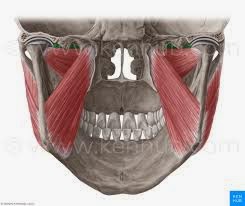
I love any name with a silent "P," and that includes "Pterygoid."  This jaw muscle and I go way back. In my early years of practice as a Physical Therapist, I worked at a clinic specializing in Temporal Mandibular Joint (TMJ) Dysfunction, commonly known as "jaw pain."  Since this muscle is involved with opening and closing the jaw, it can really cause problems when it does not function properly. 

There are 2 divisions of the Pterygoid muscle, the internal or medial fibers, and the external or lateral fibers of the Pterygoid. The Internal/Medial pterygoid has 2 heads, one deep and one superficial. The deep head inserts onto the side of the sphenoid bone, which sits behind our eyes. The superficial head originates from the palatine bone on the roof of our mouth and the maxillary tuberosity which is a bump behind the top back teeth. Both of these heads insert onto the inside angle of the jaw bone, or mandible. The medial pterygoid works to close the jaw and move the jaw from side to side for chewing. 


The External/Lateral Pterygoid originates from the great wing of the sphenoid bone and pterygoid plate, and inserts on the condyloid process of the mandible, which is the part of the jaw bone that rests inside the joint, beneath a disc made of cartilage, and serves as the hinge point or axis for opening and closing the jaw. When the external/lateral pterygoid contracts, it works to open the jaw, protrude it forward, and move it side to side, along with the internal/medial pterygoid. 

What signs or symptoms result from problems with Pterygoid? Headaches, facial pain, ringing in the ear, or ear pain are some common symptoms people experience when their pterygoids are not working properly. Clicking in the joint is common when the disc is sliding inefficiently within the joint space. If the disc gets dislocated, the jaw can get stuck open or closed. The Temporal Mandibular Joint (TMJ) gets swollen from the improper mechanics of the muscles around the area, which adds to the discomfort. People who clench their teeth or grind them at night often have trouble with their pterygoids, and may also have imbalances in some of the other jaw muscles. Chewing, talking, and even kissing can become very difficult for people with TMJ Dysfunction. None of that is very fun, as you can imagine!! 

What causes problems with the Pterygoid? Muscular imbalances throughout the head, spine and pelvis can contribute to postural alignment imbalances that affect the position of the head and jaw bones, and put added stress on the pterygoids. People often injure their jaw in car accidents, or with a direct blow to the jaw or face. Some people have stress, tension, and unresolved anger issues and clench their teeth habitually. This puts a lot of stress on the joints and can worsen the symptoms noted above. 

How can we feel the Pterygoid working properly? You will feel a subtle muscle contracting inside the jaw joint as you open and then close your teeth gently. You can really feel the pterygoids inside the jaw joint as you move your jaw back and forth from side to side, gently.  You can place your fingertips on the outside of the jaw joint just in front of your ears and feel the disc slide along with the lower jaw bone. Notice if you feel one side or the other move forward more quickly or if you feel the disc popping as you move. A normal jaw will open to between 40-50 mm of opening if all goes well. 

Here's hoping your Pterygoids are doing well and keeping your mouths and heads happy as you enjoy yummy, nourishing foods and laugh and socialize with your family and friends!

Monday, April 27, 2015

April 2015 Piriformis

Piriformis

Advice on finding, feeling, and freeing up the Piriformis muscle for its full potential


Good Old Piriformis.  Even if you don't know much about muscles, most people have heard of this one. Any one who has had trouble with this muscle knows right where this guy is located!! This small but very important "pear-shaped" muscle is one of 6 deep hip rotators, located underneath the buttock muscle, gluteus maximus, on the back of each hip. Piriformis attaches to the front of the sacrum then extends deep through the back of the hip to attach onto the top of the hip bone, on the "greater trochanter" of the femur. This muscle runs right over the Sciatic nerve, which is the huge nerve that runs throughout the back of the leg, allowing us to feel and move all the muscles on the back of the leg.  


"What exactly does the Piriformis muscle do for our bodies," you ask? Well, a lot! The Piriformis muscles help to keep our sacrum stable and in a balanced position. When the hip is extended, this muscle is a hip "external rotator," meaning it rotates the hip and leg outward.  Think about the motion required to cross your leg and place your ankle on your opposite knee...thanks Piriformis! The Piriformis also works to abduct the hip, or move the leg out to the side, when the hip is flexed. This motion is important during walking to maintain our balance and help us shift weight to the other side of the body so we don't fall. What I think is particularly fascinating about this muscle, is that as we "flex" the hip up to bring our thigh toward our chest, the function of Piriformis reverses to be a hip "internal rotator." Think of the motion involved at the hip as you put your shoe on or take it off with one hand while standing.  Now, I'd say those are some pretty important functions!

Want to feel your Piriformis working? Lie on your stomach with your knee bent to a 90 degree angle. Slide your bent knee slightly away from your opposite thigh. Using the Piriformis muscle deep in the hip, allow your lower leg to come across to the back of the opposite leg while still maintaining the 90 degree angle. Feel the muscle contracting in the center of the buttock area? Pretty cool, huh? Another way to feel it is to lie on your back with your knee bent all the way up toward your chest.  With the knee bent and your lower leg parallel with the floor, rotate your hip inward so that your foot moves out to the side, away from your body. Now can you feel a muscle in the back of your hip working for you? That is your Piriformis, my friend.

What happens when Piriformis is not working correctly? This poor guy gets the blame when folks have tightness or pain in the center of the back of the hip, or when they feel weakness or pain extending down into their leg. These symptoms are also known as "Sciatica" symptoms. Some people's Sciatic nerve, or parts of it, pierces right through this muscle, so that can create some of the same symptoms.  One of my biggest pet peeves is when people are told that the Piriformis muscle should be "released," or stretched to the max, as is often recommended in traditional Physical Therapy sessions or group fitness classes. Maybe the Piriformis muscle just wants to be understood, not stretched!!! Sometimes Piriformis is crying out for help as it compensates and tightens up, when the other bigger, more efficient hip rotators are not performing at their full potential. Sometimes it is crying out as to say, "Dude, STOP sitting on your wallet!!!"  Other times, the Piriformis becomes compromised if the pelvis is not in an ideal position or alignment due to other muscles not functioning properly. It may just need a little reminder of how is is designed to work properly throughout its entire range of motion, followed by some re-education activities.  A whole body assessment must be performed to truly identify if the symptoms in the hip and leg are from an injury to the actual Piriformis muscle itself, or if the symptoms are simply your body's way of getting your attention to help a bigger issue.

Over the past 16 years of Physical Therapy practice, this muscle has been the recipient of many of my treatments. Ever since becoming a Muscle Activation Techniques (MAT) Certified Specialist in 2010, I have changed my approach to assess for weakness and then specifically re-activate and correct the imbalances in and around the Piriformis, which has taken my clients results to a whole new level. I have to say that it is a whole lot more fun for all of us than the old way I used to treat, using my elbow to dig out the tightness, followed by a stretch. For those of you who worked with me prior to 2010 for your Piriformis issues, I do apologize for any discomfort I may have caused you.  I promise to make it up to you should you choose to try some new and improved Muscle Activation Techniques treatments... :)   

Wednesday, February 4, 2015

February 2015 Transverse Abdominus


TRANSVERSE ABDOMINUS


Most of you already know I am a total NERD for muscles, but I LOVE this one!  This muscle is the deepest abdominal muscle in our body, underneath all the other core muscles, but it hardly gets any attention. Most everyone knows about the "Obliques” on our sides, and the one in front that makes the 6-pack, “Rectus Abdominus”, but “Transverse Abdominus” is the most important one, in my opinion, and some people aren’t aware that it exists!  Transverse Abdominus (TVA) is a ginormous muscle, spanning from the bottom of our spine (Lumbar vertebrae 5, 4, 3, 2 and 1) wrapping around (transversely) both of our sides, connecting to the top of our pelvis from back to front, running over the top of Rectus (like a kangaroo pouch) and then attaches to the middle connective tissue of our abdomen, known as the “linea alba”.  That's just the lower fibers!!  This dandy’s upper fibers extend up the entire front of the abdomen underneath Rectus, and ends it’s journey connecting into all the lower front ribs, near the bottom of our breastbone. Phew!!  Now that’s a dandy, am I right???

So, now that you know where it is…what does TVA do for you??  Well, tons of stuff, actually.  This muscle functions as an “internal girdle” for keeping our abdominal organs in place, helps to promote the important process of carrying and delivering a baby, and is used to remove the “junk” out from our digestive system through elimination.  On a more fun note, TVA is the main muscle that contracts during a belly laugh!  How about keeping our pelvis in a stable position? Well, we can thank the TVA for that one too. With a stable lower spine and pelvis, our arms have the proper neurological recruitment patterns for efficient upper body movements.  If that isn’t enough, there’s more!! By contracting the lower fibers of this guy, we can twist our pelvis and trunk/spine to the same side. By contracting the upper fibers, we can twist our ribcage and spine to the opposite side.   This muscle also helps us to bend our trunk to the side, as well as flex or bend it forward when we touch our toes, or do an abdominal “crunch.” This is one busy muscle!

How do we isolate this lovely muscle?  Some would say: “Pull your navel into your spine.”  That gets it somewhat, but to really isolate it more specifically, Muscle Activation Techniques (MAT) teaches 2 different ways, one for the lower fibers and one for the upper fibers.  Want to try? For the lower fibers, lie on your back with your left knee bent and foot resting on top of your right thigh. Feel the left abdominal area between your pelvic bone and bellybutton. Now lift the left side of your pelvis up and over toward the right side, as if trying to reach your left knee up and over to the corner of the room where the right wall meets the ceiling. Feel it? Now try that on the other side and compare what you feel each way. For the upper fibers, sit on the edge of a chair with your knees straight and feet flat on the floor. Turn your torso to the right as you feel the area contracting between your left ribs and the middle of your belly. Got it? Now reverse it, and again, compare the sensations you notice.

You may be wondering, “What would I notice in my body if the TVA is NOT working properly??”  Well, that is a very good question. Weakness in the TVA can lead to all sorts of issues including lower back pain/tightness, neck pain/tightness, radiating pain/weakness/numbness into the leg(s), inability to reach arms overhead, poor bladder or sexual control, decreased ability to assist a bowel movement, difficulty delivering a baby, poor digestion, and more. Ever experience any of these?

We want to be sure that both sets of fibers on each side of the body are working throughout their full range of motion before we do strengthening exercises, just like any other muscle in the body.  Once we are certain that TVA is working and you can feel the precise areas being isolated, you can perform many different strengthening exercises to target this area. Planks, abdominal curls (“crunches”), torso twists, windmills, burpees, mountain climbers, pelvic tilts, and knee to chest marches, to name a few.


As a Muscle Activation Techniques (MAT) Certified Specialist, I can precisely check your TVA muscles and make sure that they are performing their jobs efficiently. Who knows, maybe we can have a belly laugh or two in the process, to help them along! : )